

The main problem that the movie “Interstellar” aims to solve is not gravity in the scientific sense but understanding attraction, which humans translate as love. Love is a force that pulls our being towards a person, object, or habit. People can love things that are either beneficial or harmful to them. Thus, the characters are really trying to solve the problem of love and its understanding.
When the Earth is filled with dust, it symbolizes a lack of clarity in the human body—a cup that cannot be seen through. This signifies that a multiplicity of ideas creates confusion about what is worthy of love and forming a hierarchy of love for a higher meaning. Cooper realizes this by the end of the movie, acknowledging that he was chosen to convey the gravity equation to Murph by entities we do not yet understand from the future. This scientific explanation is an inversion of the deeper truth. Many viewers are put off by the idea of using “love” to solve the equation because modern society seeks scientific answers. However, this is because we generally do not understand love at a high enough level.
The story’s true essence is about Cooper using a black hole to communicate with his daughter, symbolizing a deeper human connection. The 5-dimensional beings Cooper refers to could be his ancestors, living through him with a higher calling. These unconscious forces guide him, which he interprets as future beings, but they might as well be his higher self, providing insights he didn’t realize in the past and altering the future.
Cooper needs to understand time, a complex concept. Symbolically, time is associated with the serpent in Paradise or Eve, the feminine principle—the anima in Jungian terms—bringing wholeness to the psyche and spirit. Time is chaotic and confined to material things, making each planet a burden, where time encloses objects to create moments or memories.
Imagining the storyline without NASA, space travel, or solving the gravity equation with quantum data, the real story is about preventing confusion in modern society. Scientific answers to spiritual questions create multiplicity and confusion. The main question for a girl growing up today is: Who is the ghost in the bookshelf? This question is crucial as it involves raising our forefathers’ legacy and understanding that we live at the pinnacle of what our ancestors built, having knowledge of facts but not meaning. Meaning gives us the “why” that can help us bear any “how.”
In reality, Cooper represents Murph’s mind as she grows up. He cannot answer her questions until he sacrifices himself by entering the black hole. Symbolically, Murph crosses the threshold of understanding by willingly jumping into the unknown. Conversely, Cooper sacrifices his rational mind to embrace the basic function of the mind—love, the ability to attract. No matter where he goes in time and space, his love for his daughter remains closest.
Murph opens her heart when reminded of her childhood, realizing that Cooper always loved her and that he is the ghost in the bookshelf. He has always been with her in spirit, guiding her through life.
The Main Symbolism in the Movie (A Book on the Bookshelf)
The movie “Interstellar” delves deeply into the symbolism of spiritual hunger. One way to understand the symbolic themes in a film is by examining the first symbolic pattern presented. In the opening scene, we see a dusty bookshelf. While there are many books on this shelf with symbolic significance, the first one that catches my eye is “Out of the Blue.” According to Goodreads, this book “is for every woman who has let a breeze of doubt turn into a full-blown hurricane.” This symbolism reflects a woman who begins to doubt her husband, leading her to question everything about her life and him.
This general pattern symbolizes how a woman copes with unresolved confusion. She will continuously test the man and emphasize her confusion if her questions are not answered properly. In “Interstellar,” we see that Cooper’s anima or feminine principle has questions he cannot answer. He tackles this issue by seeking the root of the answers rather than the root of the questions. This reflects our society, where scientific answers are often provided for spiritual problems, creating more confusion and multiplicity—or metaphorically, more dust on reality. As a result, it becomes harder to see reality clearly due to the confusion and unanswered questions.
The upside-down plates in the movie symbolize rejected spiritual knowledge. Since the dust does not enter their meals, it cannot be transformed into unity. The books covered in dust also represent scattered knowledge, and more specifically, the diminishing faith in knowledge due to a multiplicity of ideas lacking unity. This multiplicity is symbolized by the dust in the movie.
What do Cooper’s and Murph’s dream try to tell them in the beginning of the movie?
In the first scene featuring the main character, Cooper, he wakes from a dream where he is in a plane, with a robot taking over the cockpit. Cooper yells at the computer to not take control, but the computer informs him that it is shutting everything down. Cooper desperately shouts, “No, I need power up!” He then wakes up to find his daughter Murph, who tells him she thought the ghost she had been seeing in the house was Cooper.
This ghost represents Murph’s quest for understanding things that are not immediately comprehensible through scientific means. She is seeking spiritual answers, looking for deeper underlying reasons for how reality works (Figure 1).

Figure 1. Answers and questions.
In the opening scene, Cooper dismisses addressing his own dream, which signifies that his rational brain is taking control when he is “above” in a plane, and that he has no control over his cognitive resources due to his strict logical approach and insistence on conscious reality. The plane represents a vessel anchored in his thinking function, which he uses to protect himself but in reality traps him, putting him at risk of the plane itself steering his direction in life without his control.
Moreover, Cooper dismisses Murph’s inquiry about the ghost being Cooper and tells her to go back to sleep. The idea that the ghost is Cooper symbolizes that Murph, the new generation, is walking on the knowledge of a ghost. We later discover that the ghost appears at the bookshelf, a source of knowledge. Murph, embodying the feminine aspect, is confused about her father’s existence in the bookshelf. Her father represents not just Cooper, but the culture she inhabits. She understands the importance of addressing this aspect and believes the ghost being her father can make sense.
In Jungian psychology, one’s conception of a father is not only the physical aspect of a biological father but also ties to a broad category encompassing everything that is masculine. In ancient biblical cosmology the heaven encompasses fatherly things while the earth encompasses motherly things and this dynamic is always exchanging and intertwining like the flow of life.
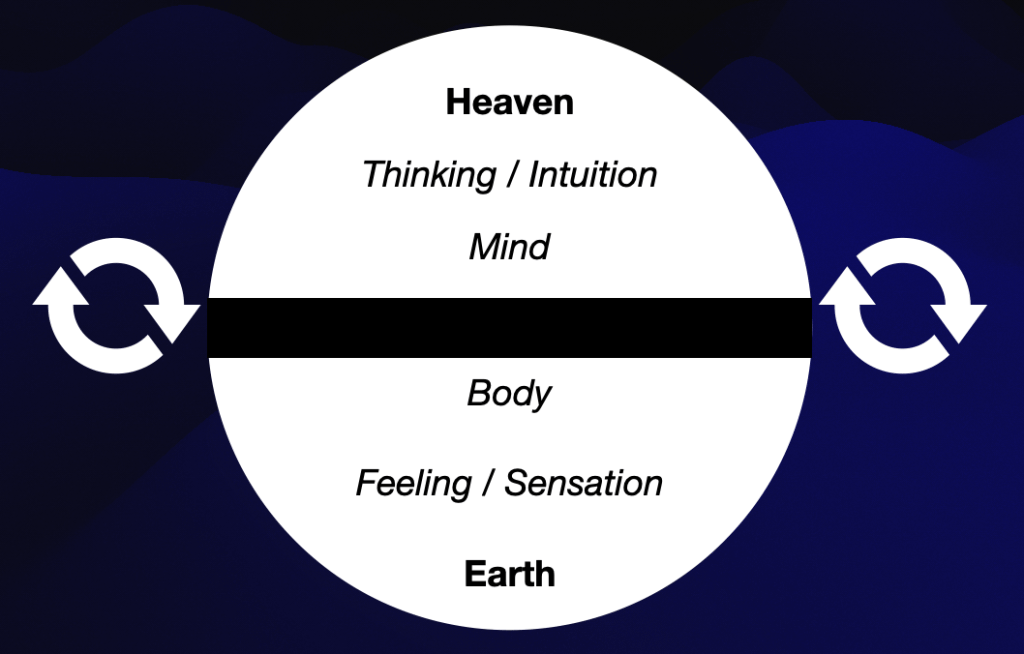
Figure 2. Heaven and Earth. Heaven as thinking and intuition (masculine) and Earth as feeling and sensation (feminine).
As we will find out at the beginning of the movie, this symbolic pattern relates to a broader cultural and historical perspective where the time they are living in is filled with dust. The movie also presents a scenario where crops are dying out and there will be a lack of food. This, in reality, has little to do with the environmental catastrophes we are constantly warned about. We need to think symbolically about this and understand why this perception is so tightly fused to our psyche.
In the movie, the entire Earth can be seen as one body, much like Cooper’s. We discover that he has lost his wife to cancer, a disease where cells fail to regenerate. This loss signifies Cooper’s disconnection from the world and his struggle to explain to Murph what she truly needs.
There’s an analogy about the renewing power in Cooper being suppressed by the ‘Negative Wise Old Man,’ represented by Dr. John Brand, who does not believe in humanity’s ability to innovate and overcome environmental challenges. This pessimistic view stems from a narrow sense of our place in history and a lack of intergenerational knowledge.
In modern Western society, we see a ‘meaning crisis’ where people struggle to address spiritual problems, often masked by material longings. This confusion, symbolized by ‘Dust,’ makes it hard to distinguish between the needs of the body and the spirit. Environmental worries can be seen as symbolic of a broader concern for the body’s safety. The Earth, analogous to one’s body, reflects these anxieties. Without innovative solutions, this leads to confusion and an overemphasis on the protective and devouring mother archetypes within our psyche (as discussed by Neumann and Freud).
The invisible father (the ghost) within a woman serves as a source of wisdom. A woman’s relationship with her intellect is channeled through her conception of a man, her Animus, while a man’s creative energy relates to his sense of a woman, his Anima. Thus, Murph and Cooper project their unconscious onto each other, with their inner child and wise old man also reflecting each other’s opposites. Their dynamic can be understood as internal reflections within a single person.
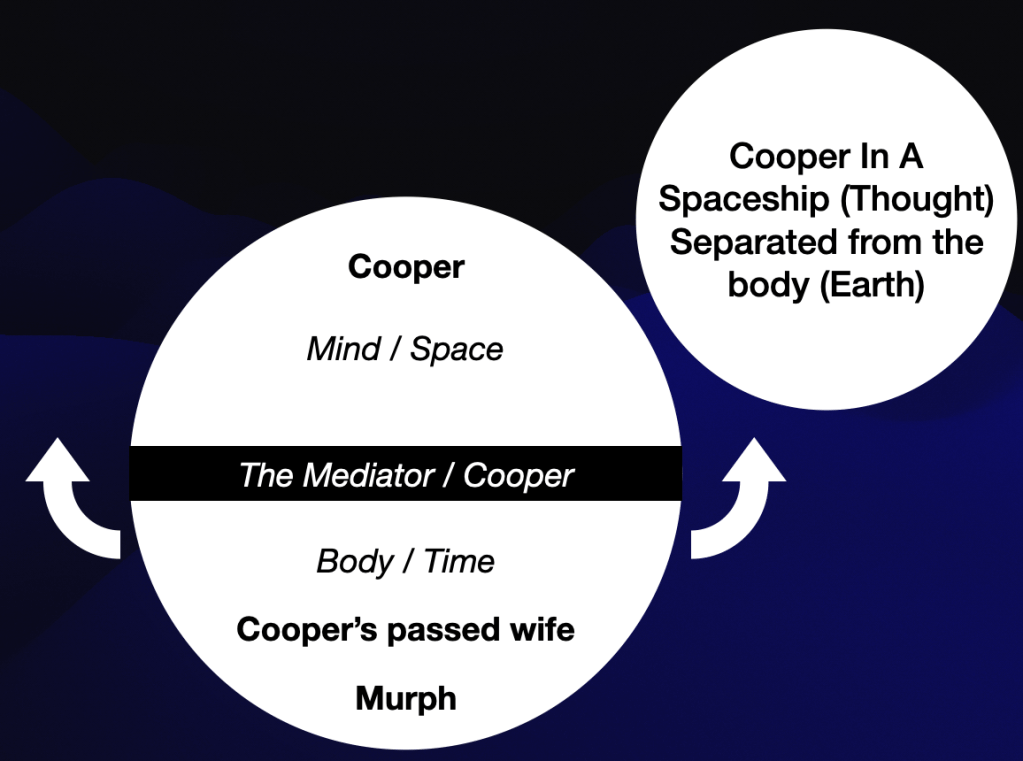
Figure 3. The mind in a vessel, uncontrolled.
NOTE: Keep in mind that symbolism is related to real events in life. This video only explores the symbolic interpretation of the symbols presented in the movie. These symbols are not meant to be interpreted solely as mental constructs. Instead, they shed light on aspects we are often blind to because we are unconscious of many things. The tricky part is that we do not know what we are unconscious of, and we are often unaware of what we are conscious of unless we bring it to light.
An example of this is being drawn to certain interests without knowing why we are interested. We can say or do things unconsciously without understanding the reasons behind them. Depth psychology, as suggested by Carl Jung, provides answers through how our ancestors laid out symbols and how archetypes are everlasting patterns of behavior within ourselves.
An interesting parallel to how attention is directed is found in how Carl Jung conceptualized the symbol of winged chaos. Balancing the masculine and feminine principles upon attention, “winged chaos” leads to guiding it towards a higher good (Image: See Jung on psychology and alchemy).
When a man cannot connect with his anima (in Jungian terms, his inner feminine), he is only consciously engaging with his logical thinking function. This is strongly symbolized when Cooper drives through the cornfield with his daughter and son to capture a surveillance drone. The surveillance drone represents Cooper’s attention, which he tries to harness for his own farm. This “Cornfield Chase” symbolizes modern man’s pursuit of technology to gain power, while the crops of his land are filled with dust. Here, the dust signifies multiplicity of confusion or too many questions that obscure reality.
This difficulty in seeing the Earth clearly means Cooper struggles to connect with his own body, which is his anima, as the body is a feminine production originating from a mother. If a man cannot connect his mind to his body, he is caught between the needs of the body and the mind. The mediator between these needs is spiritual longing. Connecting with one’s inner woman is a gateway to understanding time and its significance in being bound to a body.
What does the ghost in the bookshelf symbolize?
In reality, all of Cooper’s problems can be boiled down to the question of why there is a ghost in Murph’s bookshelf. This symbolizes the children of the modern generation asking why their father is not visible in the corpus of knowledge, which today is oversaturated with scientific knowledge. Science answers the questions of “what,” but spiritual insight answers the questions of “why.”
Every scientist seeks to understand “what” is happening—a masculine question—but they are also interested in “why” it is happening—a feminine question. However, they often neglect the feminine aspect of the pursuit of knowledge. This pursuit is done for a good that is not immediately comprehensible because we do not know the possibilities that discoveries have and the positive and negative impacts any discovery or technology can have across a broader space and time.
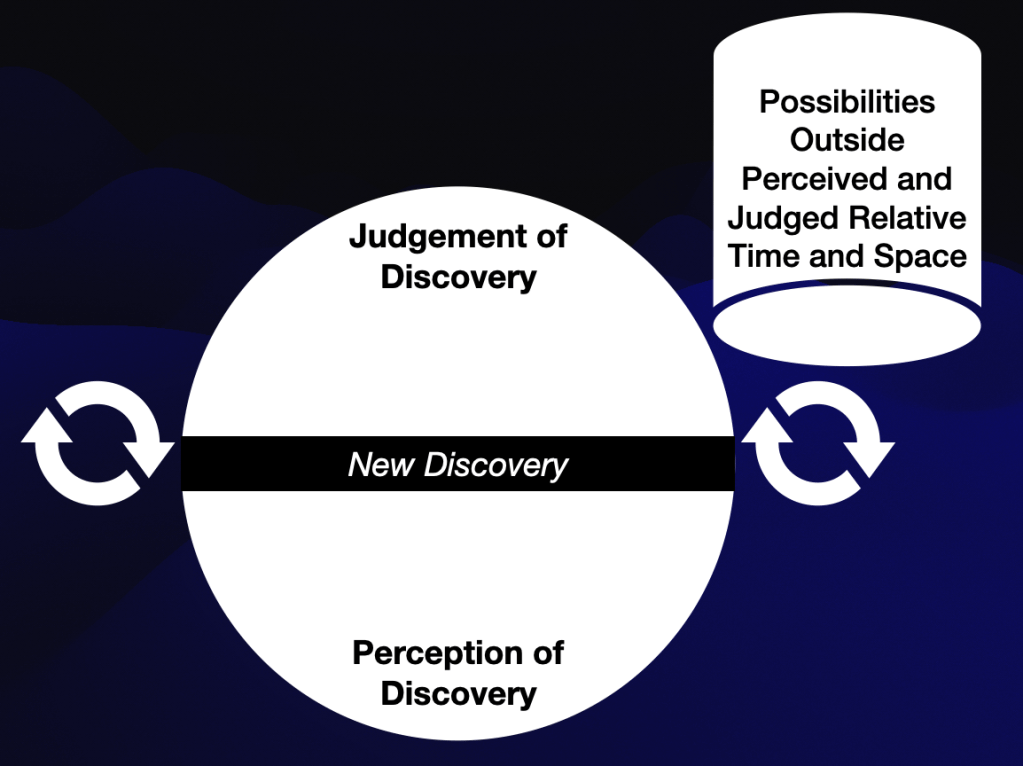
Figure 4. New discoveries and perception. The cylinder behind represents the vessel that is separated from space and time and therefore hard to believe in the confines of consciousness of time and space. Although the depths of the psyche reach beyond space and time (see synchronicity).
We find out that the drone was attracted to Cooper’s farm due to electromagnetic activity from their bookshelf at home. This activity is a calling from Cooper’s higher self, signaling what he needs to do. However, because Cooper addresses the activity logically, he ends up at NASA and later embarks on a space journey to save Earth. NASA represents the rational faculty of his mind, where spaceships are built—containers of great ideas—but no significant progress is made due to a lack of understanding of what lies beyond rational thinking and why we can think rationally beyond just evolutionary scientific explanations.
The sign from the bookshelf symbolizes Cooper’s need to communicate with his unconscious higher self, with Murph representing the mediation of this connection. We see Murph embodying this role when she steers the drone and lands it on Earth after the Cornfield Chase. However, Cooper chooses the rational path and wastes a lot of time because of this mistake.
At one point in the movie, Murph talks about the ghost again, and Cooper tells her to bring empirical evidence before discussing its existence. This reflects modern society’s strong attachment to rationality and the high value placed on scientific endeavor. It is not an arbitrary observation; most modern individuals follow a thought pattern similar to Descartes’ “I think therefore I am.” This statement prioritizes articulated reason over questions of doubt, valuing a conscious attitude of thinking, which leads to unconscious reactions of feeling—non-logical determinations based on the body’s sensations.
This inclination towards science is not just about Cooper’s mind but can be related to a broader cultural and social pattern of thought. After the manipulation of religion by the Catholic Church, religion has garnered a bad reputation, making it difficult for people to return to spiritual insights. This relates to Carl Jung’s statement that people do not have ideas; rather, ideas have people. This ties into the fact that we live in an age where ideologies have taken too much control, as people generally lack direction beyond the rational faculty.
What does the second book on the bookshelf symbolize?
A second book worth mentioning on the bookshelf in the beginning of the movie is “One Hundred Years of Solitude,” which parallels Cooper’s long journey into space—a hero’s journey into the unknown. According to Wikipedia, this book explores the theme of the inevitable and inescapable repetition of history in Macondo. The characters are controlled by their pasts and the complexity of time, often visited by ghosts symbolizing the haunting nature of their pasts. Daniel Erickson notes that “the ghosts and the displaced repetition that they evoke are firmly grounded in the particular development of Latin American history.” The protagonists are depicted as being alienated and estranged from their own history, victims of harsh realities and ideological illusions.
To relate this to Cooper’s experience, we see parallels with his future self trying to wake him up and stop him from leaving home, urging him to stay with Murph. This book subtly references the confusion often imposed on modern individuals, who struggle to respond to it and almost accept it passively. In reality, societal ideologies about equality and celebrating differences can introduce confusion and prolong time in a Biblical Cosmology and Jungian Psychology context.
This introduces too many questions that cannot be answered scientifically but can be answered symbolically and are things we intuitively know. The push of ideologies on modern children leads to confusion and a land filled with dust—symbolizing ideas that are not fruitful and do not lead to deeper meaning for every man and woman. Modern ideologies like postmodernism emphasize extreme individuality, suggesting that every book holds no truth because everyone can have their own opinion.
These notions destroy foundational truths and challenge the deeper values that unite humanity and tie man and woman together. This relationship is not just between human beings but also represents a union of opposites and a cosmological secret in understanding reality.
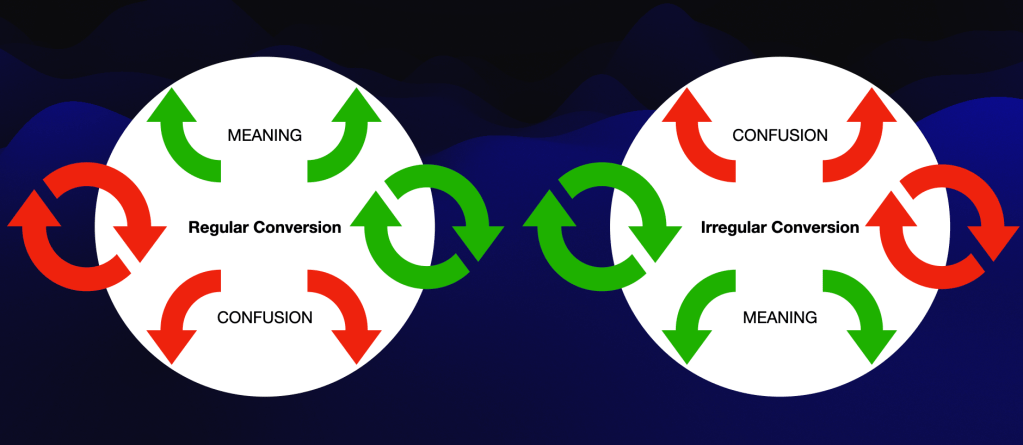
Figure 5. Confusion and Meaning circulation. E.g. Blood flows meaningfully and not with confusion.
What does it mean to chase a drone in the Cornfield Chase scene?
After Cooper’s cornfield chase, where he searches for something tangible in a field of potential, he connects to the drone and allows Murph to land it. Following this, Murph is called in for school counseling, where Cooper is confronted with the school’s new curriculum that teaches the moon landing never happened and was propaganda. This represents an extreme form of confusion being imposed on children. Cooper resists this confusion and ensures his daughter is not influenced by these ideas, steadfastly holding onto traditional values. He correctly identifies this as a form of “caretaking,” or motherly society, referencing Neumann’s book, “The Great Mother.”
As Cooper holds his ground in his quest for truth, his father-in-law Donald notices an anomaly that steers all the farm equipment towards the house. Symbolically, this indicates that when Cooper sticks to his core values, there is a magnetic pull towards the center of his being—the bookshelf, which represents wisdom. His entire being automatically gravitates towards this source of wisdom, situated at the edge of his visible reality on one side and an invisible reality on the other. This represents Cooper at the boundary between matter and spirit.
The bookshelf is the center where visible reality begins, and here, Cooper can find his true self, communicating with his higher purposes that Murph also seeks to understand from an early age. It symbolizes Cooper’s consciousness and the passage to seeing the invisible world. In the movie, Cooper believes he needs to journey into outer space to save the world. This is symbolic of the hero’s journey. However, had he listened to and believed in Murph from the beginning, he would not need to travel across the universe. He would have realized that the answers lay at the bookshelf—his own wisdom. It remains invisible because understanding these truths requires a leap of faith, explaining things beyond the immediate scope of science.
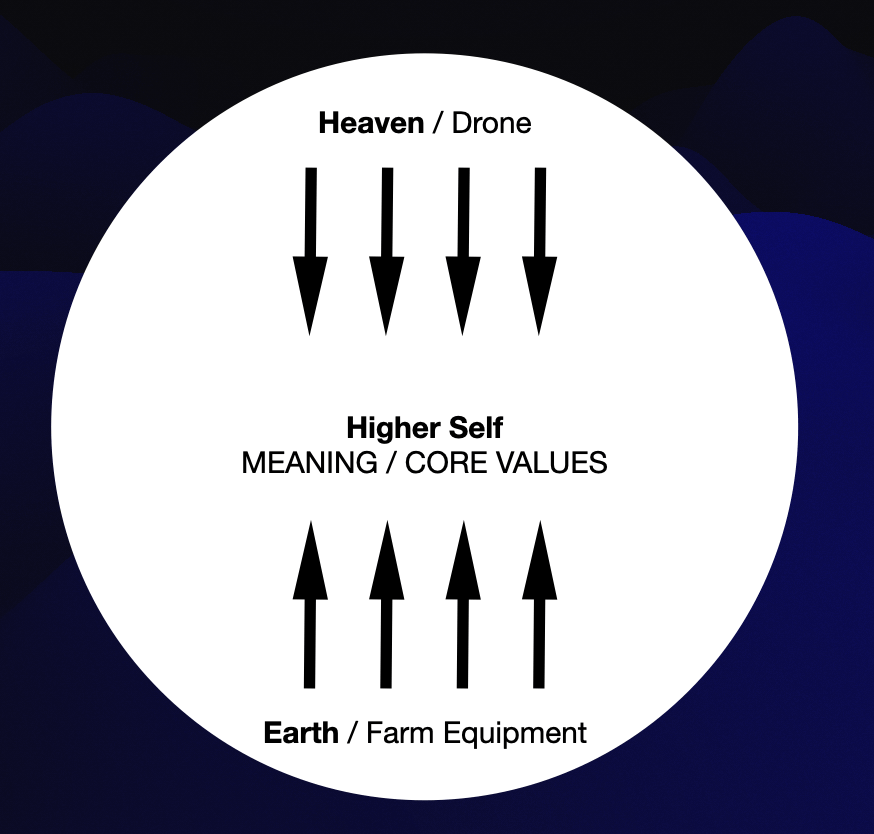
Figure 6. The drone and farm equipment as material sensations pointing towards meaning.
Understanding the deeper intuitions of reality requires a leap of faith, which Murph represents to Cooper. Alternatively, we can invert the symbolism and see that through Murph’s individuation process, she must understand that her father travels through space because he does not grasp what lies beyond science. He needs to reconnect with the invisible world of spirit and faith. As an adult, Murph’s animus is developed, and Cooper represents her source of wisdom.
Conversely, Cooper’s source of wisdom, which can solve his problems and turn dust into meaning, lies in connecting with his anima. This anima is represented by an underdeveloped form of Murph since he lost his wife, leaving his anima in a childlike state. A man’s source of wisdom comes from how he relates to his body, which brings deeper intuitions of reality when he is empathetic towards a higher union he cannot comprehend. Conversely, a woman’s source of wisdom is the function of relating to the mind. This occurs when a woman connects her body to her mind by giving herself up to a higher meaning.
The journey in “Interstellar” symbolizes the entire individuation process of a man and woman living in a world filled with dust, where spiritual meaning holds little value in a scientifically overvalued and confused society. While science greatly advances technology and extends the body, it fails to satisfy the spiritual hunger for deeper meaning inherent in every man and woman.
What does technology symbolize when Murph empathizes with a drone?
The scene following Cooper’s discovery of the anomaly begins at their house, where he converses with his father-in-law, Donald. Donald embodies Cooper’s “wise old man” archetype, remarking that Cooper was talented but never got to use his gifts. This highlights the modern struggle where men seek purpose but often revert to childish behaviors in a world rife with confusion and emasculation.
This theme connects to Murph’s question about whether the drone can be set free. The younger generation often confuses material possessions with spiritual longings, transmuting these desires into technological devices. This issue is exemplified by modern AI developers who continue advancing technology without addressing deeper spiritual needs. This masculine drive for meaning results in material creations rather than spiritual understanding. People create symbols in material form, believing they will solve their problems, but in reality, they only represent the issue on a larger scale in hope of someone else will solve their problem for them.
Technologies are increasingly replacing traditional male roles, allowing women to choose medical devices for impregnation over men. Murph’s empathy for the drone reflects her understanding of her father’s joy in pursuing a goal—a motivation he might lack after losing his wife. Cooper’s response that the drone’s parts need to be adapted for their farm signifies an evolutionary strategy of adapting purposes to their surroundings instead of following true spiritual insights.
This societal confusion, where technologies replace traditional male roles, leads to a lack of open communication between genders. Men’s desires are drained by technologies, which Freud referred to as the digital devouring mother. Modern conflicts are often mental, and society struggles to address these issues due to an incomplete understanding of the human psyche. Although psychology and the scientific method are relatively young fields, ancient symbolic patterns from texts and scriptures have historically guided humanity through conflicts.
Donald’s regret about Cooper not using his gift harks back to Cooper’s dream of the computer shutting down the plane. This symbolizes the threat of being replaced by technology. Cooper needs to reverse his thinking and fulfill his spiritual yearning by tapping into deeper intuitions, expressed through symbolic patterns in the unconscious. Carl Jung’s concept of archetypes suggests that these symbols are not just personal but collective, occurring cross-culturally and preserved biologically.
At Cooper’s heart, home, and farm are his wise old man (Donald), his anima (Murph), and his eternal child (Tom). Opening his heart symbolizes understanding the bookshelf as a gateway to deeper reality, facilitating communication between his anima, eternal child, and wise old man. This dynamic relationship between opposites requires constant communication, representing time (child and old man) and space (man and woman).
A woman can symbolize matter and time, while a man represents energy and space. Alternatively, the woman is earth and water, while the man is fire and air. Or, the man is a pattern, and the woman is matter.
Why is Murph’s Watch a messenger?
By the end of the movie, we learn that the watch holds great significance when Cooper reaches the center of the black hole, Gargantua, representing that which consumes all his attention. The black hole’s center symbolizes a psychological complex within Cooper, akin to his shadow side as he navigates the darkness. In this region, Cooper communicates with TARS, his rational mind, now perceived as a separate entity from reality. Sending TARS into the black hole first signifies Cooper consciously separating his mind from his body, sacrificing himself to gain insight.
Symbolically, solving the problem of gravity requires looking inside the black hole—understanding why one’s attention is drawn to the unknown by facing it directly. Within this space, Cooper concludes that higher beings created this three-dimensional environment for him to comprehend and navigate, mirroring how the mind accumulates memories to solve complex issues. Interestingly, this complex may exist more in Murph’s mind than in Cooper’s.
Conversely, Cooper’s own complex emerges as he dives into his unconscious, losing his connection to his female anima, Dr. Brand, during the space journey. This mirrors the biblical story of God putting Adam to sleep to create Eve, with Eve representing the unconscious reality and Adam the conscious reality, naming things.
The psychological and symbolic journey depicted in “Interstellar” underscores the intricate dance between conscious and unconscious realms, rationality and spirituality, illustrating the profound depths of the human psyche.
Why is the Black Hole a Complex Between The Scientific Mind and The Spiritual Mind and how does it relate to The Conflict between the Eternal Child and The Wise Old Man?
A complex is a collection of memories that remain unconsciously integrated due to repression. The traumatic experience of a father leaving his daughter holds profound significance. On an individual level, it means that a person must let go of their father to thrive independently, replacing the father’s influence with their own mind as they mature. On a broader scale, this relates to the decline of a spiritual father figure, where many people have lost their connection to a higher union in reality beyond their comprehension. Instead, they cling to scientific answers, which provide no guidance on how to live their lives. This direction must come from within, stemming from the recognition of a higher union of reality.
When Cooper is on the planet filled with water and waves, it represents the emotional turbulence a person experiences. Time on this planet passes at a rate where seven years equal one hour, symbolizing how, when trapped in a complex, one fails to progress towards individuation and remains stuck in time, represented by water, which also signifies the unconscious. Many people lose their sense of time because they have lost touch with their inner child. This is linked to the symbolism of “Time is a child” (referencing Jung’s inscription). After leaving the planet, Cooper is devastated upon returning to the space station and seeing his children grow up through video transmissions without having been there for them. This also reflects how the modern rational man struggles to connect with his own inner child and his children, feeling like a spectator in their lives, unable to act with feeling and empathy due to a limited rational mind.
At one point, Cooper claims that love is for social utility and practical purposes, which Dr. Brand challenges by questioning the utility of remembering the dead. In the black hole, Cooper realizes that love is the key to sending a message through space and time to Murph, though he still does not fully grasp the higher union in reality, perhaps because it is too soon for him.
When Murph returns to the bookshelf as an adult, she is reminded of her childhood, and her empathy towards her father grows. The memories of experiencing a ghost in the bookshelf symbolize her father pushing her towards knowledge beyond the confines of a scientific and materialistic world, reminding her that he is always with her as a source of wisdom. As viewers, we rationalize why Cooper is in the wall and discuss TARS receiving quantum data—TARS being an anagram for STAR—and Cooper delivering information by tapping Morse code on Murphy’s childhood watch.
From a scientific perspective, these elements make sense, but symbolically, they represent Murph resolving her inner conflict. She realizes that Cooper always loved her and always will. This realization, which Murph struggled with throughout her adulthood, shows that Cooper’s message, tapping in Murph’s watch, is a reminder of her inner child. Recognizing one’s inner child is crucial for being a loving adult. When Murph embraces this, she transitions from hating her brother to loving him, symbolizing her acceptance of her masculine counterpart and her inner child and father.
This reminder of the inner child is profound and highlights how adults can forget to integrate their inner child, which leads to wisdom in the form of a wise old man. It is especially challenging in the modern world, which values the rational mind while the child holds no higher value.
What does Carl Jung’s Bollingen Stone have to do with the movie “Interstellar”?
As one of Carl Jung’s final works inscribed near the Bollingen Tower reads:
“Time is a child — playing like a child — playing a board game — the kingdom of the child. This is Telesphoros, who roams through the dark regions of this cosmos and glows like a star out of the depths. He points the way to the gates of the sun and to the land of dreams.”
This connection to the unconscious in a playful manner allows one to receive messages from the future, unlike Cooper, who spent his life rebuking such messages through the bookshelf. Embracing this playful connection enables the mind to think in a dream-like state even when awake, revealing deeper meanings in reality that are not immediately comprehensible. This is akin to Jung’s concept of synchronicity—relationships between non-causal events.
What Cooper realizes is that it is possible to send a message through spacetime. This concept is crucial to understand, as a psychological complex from a traumatic experience acts as a transmitter of memories. It conveys a message to the individual, indicating that they can solve the blockage in their personal growth by focusing on it. However, many are afraid to confront it. The human mind, therefore, transcends space and time, as theorized by Carl Jung with his theory of synchronicity.
What does Saturn symbolize?
Another fascinating aspect of Jung’s stone is the alchemical symbol of Saturn inscribed on top. It’s no coincidence that the first planet Cooper heads towards is Saturn, and at the end of the movie, the space station orbits Saturn. In Roman mythology, Saturn is the God of Harvest, symbolized by the scythe, which resembles the number “4”. Saturn represents earth, and in ancient symbolism, anything corporeal and material was often depicted as darkness because it needs light to have meaning. Saturn also represents the sensation function, focusing on material things, which can dim the inner light and lead one away from higher spiritual significance.
We see this represented when Cooper loses his spaceship as he enters the black hole, left only with his suit. This symbolizes shedding his rational mind and ascending to a higher, more exposed state.
Jung’s stone inscription is a mandala, with the top quarter representing Saturn. Jung deeply explored ancient symbolism, and Saturn signifies time and darkness. While I can’t cover all the symbolism of this stone in one discussion, it’s noteworthy that Mercurius, represented as Telesphoros, is the light seeker at the center. Mercury, a liquid metal at room temperature, can pick up all the gold when poured over ore, symbolizing the psychological guidance towards “gold” or higher value.
Cooper’s golden light is revealed to him as a message from the ghost in the bookshelf, symbolizing his higher self. Similarly, Mercurius serves as the messenger of the psyche, balancing the poisonous and healing serpent, much like Moses lifting the staff in the desert.
These rich symbols intertwine the personal journey with ancient mythological and psychological insights, adding depth to Cooper’s exploration of the unknown.
What does the “Lazarus” mission symbolize?
Cooper reaches a pivotal point where he takes control of his life and directs it towards a higher good after overcoming the encounter with Dr. Mann from the “Lazarus” mission, portrayed by Matt Damon. The “Lazarus” mission consisted of 12 astronauts, with Dr. Mann being the sole survivor, hinting at his betrayal of the crew. Dr. Mann embodies the spirit of Cain, whose sacrifice was insufficient. We discover that Dr. Mann sent a signal to Earth solely to save himself, demonstrating his lack of faith. Cooper wakes him up, referencing the Christ story of awakening Lazarus. Dr. Mann symbolizes the part of Cooper that had lost faith and needed confrontation. As Dr. Mann attempts to escape the lifeless planet—void of God and spirit—Cooper and Dr. Brand warn him not to connect to the space station. Ignoring their warnings, Dr. Mann’s cowardice leads to his demise, destroying his spaceship and one of the 12 space shuttles. This parallels Judas, one of Jesus’ 12 disciples, who betrayed Christ.
Cooper awakens after Dr. Mann’s death, defying computer calculations to take control of the space station, which is about to crash. This awakening force within Cooper ignites when he believes he is going to die on Dr. Mann’s planet, awakening his spirit. This is the spiritual will that defies all rational calculations and does what it sets its mind to, regardless of external constraints.
The scene where Cooper and Dr. Brand spin their vessel to match the space station’s rotation, resembling a mandala, signifies Cooper aligning his masculine and feminine principles. The 12 rooms in the space station symbolize the 12 disciples or zodiac signs, representing the main patterns of reality. When these patterns align with Cooper’s balanced principles, he gains full control over his life. Unlike the passive approach of “going with the flow,” Cooper actively aligns himself with the mind’s movement, guiding it deliberately. Like a wild animal or a lost man in space moving in 12 directions, Cooper must enter the center to take control—a challenge in modern society, especially with the hyper-exposure to mobile devices evoking irrelevant feelings.
These 12 patterns of actions correspond to the 12 zodiac signs, which in Jungian alchemical symbolism are ruled by the sun, moon, Mars, Venus, Jupiter, Saturn, and Mercury. These positions, mapped out on Jung’s Bollingen stone, represent the inner workings of the mind and their projections. There is much more symbolism to explore, but that might be a topic for another discussion.
Why the name “Cooper” and what does have to do with dreams?
One interesting observation is that the name Cooper closely resembles Copper, the metal associated with Venus. In Jung’s Bollingen stone, this is the quarter on the right, representing unconscious feelings. It’s where the moon is, symbolizing Cooper as a connection to the dream world for Murph. His name, Joseph Cooper, also echoes Joseph from the Bible, who had a coat of many colors and was an interpreter of dreams. In this symbolic pattern, Murph is akin to Mercury, which embodies dual symbolism of masculine and feminine. This aligns with Cooper being the key to her imagination, as Murph’s childhood memories of her father in the bookshelf saved her from an overly rational mind devoid of spirit. This connection allowed her to receive the wisdom needed to solve her own and the Earth’s spiritual problems.
In alchemy, copper is linked to Venus, symbolizing love, harmony, and the intermediary stages of transformation. Cooper’s quest to solve the equation of gravity can be seen as a journey toward harmony and balance in a chaotic universe. Gravity, as a fundamental force, represents the unifying element that holds everything together. Solving the equation of gravity symbolizes the quest to understand and unify the fragmented aspects of existence, both scientifically and spiritually.
Another notable reference is TARS. TARS is an anagram of STAR, symbolizing the inner star or the sun. Jesus, often associated with the sun as a solar figure, is mirrored through TARS as a robot communicating with Cooper in the black hole.
The 3D representation Cooper sees in the black hole illustrates how the mind makes sense of a complex—a collection of emotionally charged memories. The planet’s time dilation refers to how the mind navigates reality and synchronicity. The black hole represents attention consumed by an unconscious complex, blinding one to its root and interaction with the conscious mind.
Cooper becomes a four-dimensional being because he can influence space and time, a realization with broad significance. However, Cooper fails to understand that this transcends science. As a result, the movie does not end with him balanced but instead sends him on a quest to find Dr. Brand, who is somewhere in the universe. Having seen both the beginning and the end of his daughter’s cycle, the proper pattern would involve communicating with his future self. Yet, his closed mind keeps him from embracing anything beyond science until he experiences it, costing him tremendous time.
This is where Cooper becomes Joseph, the dream interpreter for Murph. He answers her very first question in the movie, affirming that her imagination, which transcends scientific rules, can become reality. He also resolves his own dream of not controlling the ship in the first scene, ultimately taking control of his journey despite the computer’s input. This shift signifies that he no longer listens solely to his rational mind but to his intuition, as Murph does.
Why is the space station formed as an “O” at the end of the movie and how does it relate to time as being cyclical?
At the end of the movie, Cooper is rescued by a new space station near Saturn. This station is a strange place where kids play baseball and the ball flies directly upward, hitting the window of a house. This scene is reminiscent of the dream world in “Inception,” where buildings rise in a stacked manner. The symbolism here is that Cooper now perceives a world saved from the dust. We also see Cooper relaxing on the porch with TARS (Star), watching the night sky through a circular window, reminiscent of the Ouroboros symbol.
To explain the symbolism of the Ouroboros, I refer to Eric Neumann’s book, “The Origins and History of Consciousness.” Neumann, a significant student of Carl Jung, writes:
“This round and this existence in the round, existence in the uroboros, is the symbolic self-representation of the dawn state, showing the infancy both of mankind and of the child. The validity and reality of the uroboros symbol rest on a collective basis. It corresponds to an evolutionary stage which can be ‘recollected’ in the psychic structure of every human being. It functions as a transpersonal factor that was there as a psychic stage of being before the formation of an ego. Moreover, its reality is re-experienced in every early childhood, and the child’s personal experience of this pre-ego stage retraces the old track trodden by humanity.”
This full circle indicates that Cooper now understands time as cyclical rather than linear. This new understanding allows him to realize how he can communicate with Murph across time to solve evolving problems.
A quick pop culture reference to illustrate this idea can be found in the video game “The Last of Us.” Joel’s watch is broken when his daughter dies but is fixed when he reconnects with Ellie. Spiritually, this signifies a reestablishment with the anima in a child-like form. An adult’s sense of play is crucial for staying in tune with time.
This child-like anima form is also evident between Murph and Cooper. There is a timeline connecting them, with Cooper remaining a steady figure throughout the movie, even though he is 120 years old in Murph’s timeline. Cooper represents the mind in time, which doesn’t age, though its expression through the body diminishes as bodily functions slow with age.
Murph realizes that her father is always with her, ready to provide the answer to save Earth, which ultimately saves both Cooper and Murph from the dust, symbolizing a lack of spirit. When Murph revisits her childhood and sees the watch, representing her inner playful side, she gains spiritual understanding. She realizes that her father was the ghost in the bookshelf all along.
However, Cooper initially fails to deliver the message properly because of his late realization. He sets things in motion rationally before understanding the right communication through Murph’s time. Time, represented by Saturn, mediates the message. As such, time becomes the dominant theme in Cooper’s journey, teaching him a lesson about its significance.
The problem arises because of a mismatch between teaching Murph scientific rigor and allowing her to play with her imagination. This pattern creates confusion and misalignment in time. Balance is achieved by integrating the child with the old man, found at the bookshelf—the source of wisdom in time.
Thanks for reading 🙂 Remember to be playful with love.
All the best,
Alan Olewnik


 The Symbolic Universe
Leave a comment