
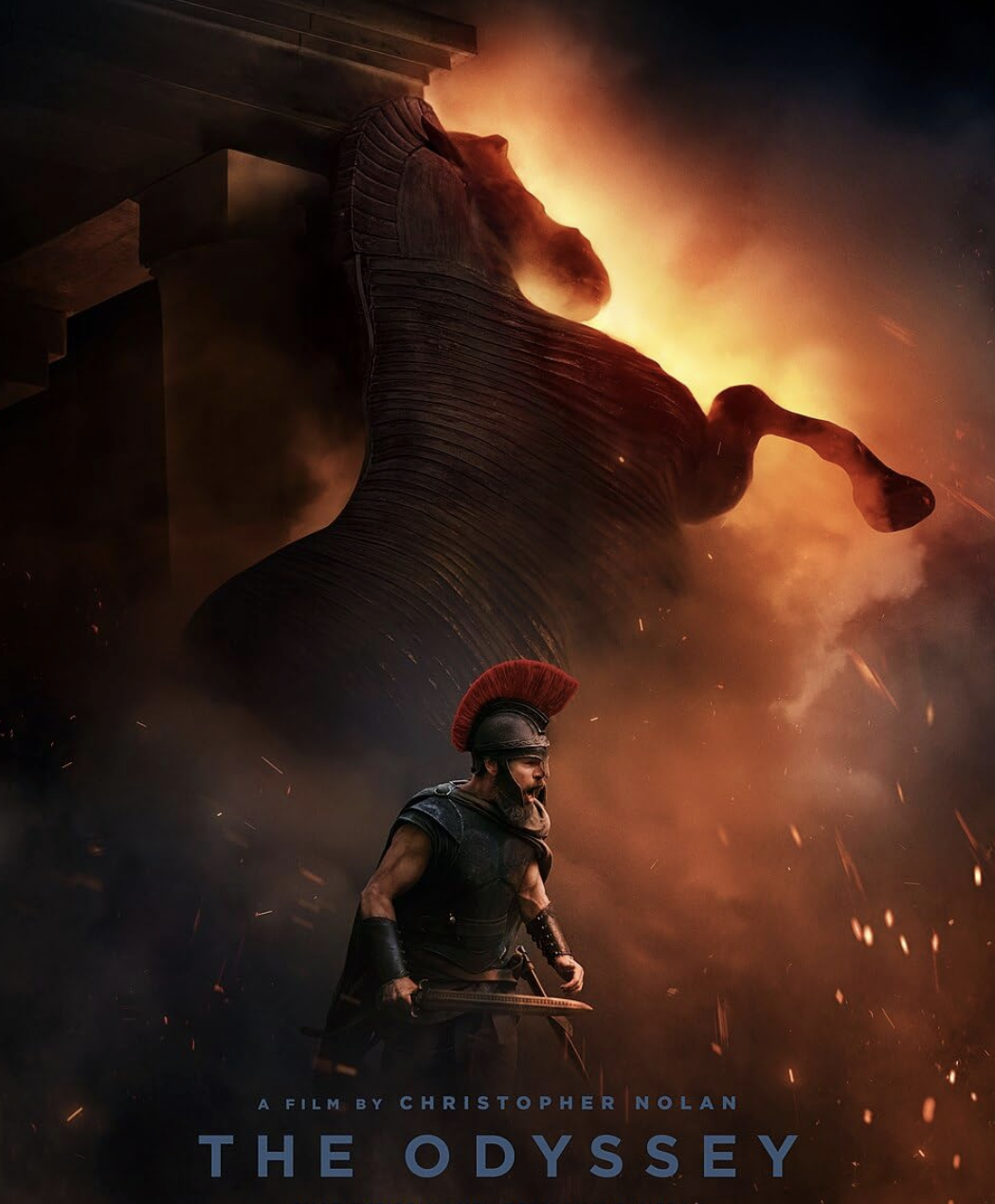
This article contains spoilers of the movie The Odyssey by Christopher Nolan.
An interesting start to this article is to learn what Christopher Nolan responds to the question of what “the gods” are in the movie “The Odyssey”.
Interviewer:
What are the gods?
Are they figments of imagination or are they necessary noble lives?
Christopher Nolan:
They are to the characters in the story. They are reality. And what I found interesting about looking at the idea of gods and how to address it. The way I got interested in addressing this from the point of view of people who would have lived in that time for whom in a pre-scientific era evidence of divinity is everywhere.
And so the existence of gods is not an article of faith. It’s simple reality. So thunder and lightning is God speaking to them. The state of the ocean is moved by the gods. They have no other explanation for it.
And so just as we accept things from science as absolute fact. You know the earth is round and we travel around the sun. We can’t know these things. We take them as as faith because they’re presented as facts. The same would be true of the theological structure that explains nature to people at that time. And so for me the gods are real but they are inside the people. They are being projected by the people.
(Source Youtube: https://www.youtube.com/watch?v=wa4I8Ch2TRo)
(Original Source Bill Billi: https://www.bilibili.com/video/BV1vdGK6GEQE/).
Intro
The Nolan adaptation of Homer’s Odyssey is a movie filled with deep symbolic themes. Nolan introduces several jungian twists in his symbology and there are also several biblical references.
As with my other articles I’d like to emphasize the perspective that every character in a movie is merely an extension of the psyche of the main character of the movie. Just as every sort of attention we give to reality are certain psychological principalities that momentarily rules over the other. Therefore I treat every appearances, characters and actions in the movie as extensions of the worldview and psychology of Odysseus.
There is no right or wrong symbolic analysis, but when exploring symbols and patterns in these kinds of stories, patterns emerge, which undeniably repeat throughout deep symbolic patterns linked to biblical stories or even greek mythology. I am always trying to look for these patterns and see how something very obvious clicks or how different thematic patterns emerge through an analysis. Nolan explicitly names the principle of “[…] do to others what you would have them do to you,” as Zeus’ law. We know this from Matthew 7:12 as the Golden Rule, and Nolan thematically explores what consequences follows from breaking this law after the trick of the Trojan Horse. The movie lays out a great psychological portraits of monsters, giants, witches, gods, and environments, which Odysseus encounters after having broken this sacred law that keeps the bond of love in humanity.
The Cyclops
The famous scene, where Odysseus and his men enter the cave of the Cyclops. After Odysseus victory in Troy he sails his own path with his men, raiding villages, until their encounter with the Cyclops. The Cyclops is a giant with one eye, a “Cyclops”, which also means “circle” or “wheel” in greek referring to the eye, and this encounter clearly represents Odysseus’ single eyed stubbornness. The Cyclops governs the cave in which Odysseus is trapped. The cave is an encapsulation of an idea or thought of the psyche, in which Odysseus is trapped. He is confronted by his own conscious one-sidedness and his psyche is luring him in for conscious confrontation, which he tries to avoid. The cave in the scene is more akin to a tomb, as the devouring aspect of the feminine. This devouring aspect of the mother is also laid out by Neumann in the “The Great Mother”, and shows how the cave becomes a forcing confrontation with Odysseus own psyche. Caves are parts of the psyche where revelations can occur, which gives birth as a womb of new ideas and perspectives on life. Here we also see an allegory to Plato’s cave as it becomes a place of Odysseus exiting the darkness of having this one sided view of obeying “Zeus’ Law”. As the men entered the cave Odysseus insisted on staying and waiting for resident of the cave to return as he was certain that they would be treated as guests fairly. The same kind of certainty in “Zeus’ law” that Odysseus direly used against the trojans. There is also a strong allegory of the “Trojan Horse” representing a “devouring mother”, or a “tomb” as it is a hidden message of death. Seen as a gift, but in action it deceives and brings misfortune. This reversal of a gift hidden as a poisonous stab is like a compliment to another person that secretly is an insult, or a favor asked, which secretly is a demand. These types of inversions always lead to an imbalance in the short or the long run, and they will be compensated for as like a natural law. In the western world we still call it karma, which is translated to a “deed”, but we know it as a kind of moral compass, where many good deeds build towards good outcomes and vice versa. The key point here is that the imbalances caused by taking advantage of other people’s goodness is that it will lead to a compensation either consciously or unconsciously.
The Cyclops can represent an autonomous complex, which matches Odysseus’ one-sided perspective after winning the war. He dares not to confront the full spectrum of his deeds yet and therefore he consciously tries to restrain his perspective. The stone is moved by the giant when the day begins and ends, so he is the mediator and the one controlling what passes into consciousness, or he chooses what reaches daylight. The moving stone is analogous to the story of Lazarus (John 11:38), yet it is not a resurrection of the dead, but it is an escape from death. The cyclops also reminisces Christ as a shepherd (John 10:11), and Odysseus is the wolf who does not save one sheep from the flock, but follows it to capture the flock like a predator. Because we are seeing the unconscious compensation, we start to see inversion of archetypes as the one’s mentioned. We know of a good shepherd that even goes to save one sheep strayed from a hundred (Luke 15:3-7), but we see Odysseus not killing one of the last sheep because he wants to lead it to its flock, more akin to a greedy wolf than a shepherd. Again we therefore see many of these inversions of stories, which leads to more compensation.
The cave is a womb of death and birth, and it is the part of consciousness where the ego and complex can confront each other, in the shadow. After Odysseus and his men succeed in stabbing the Cyclops in the eye, one of the men notices that the Cyclops speaks and prays to Poseidon. When one of the men suggest speaking to the giant was an option Odysseus analogously asks if he would speak to ants, and that it is too late for a dialogue. Poking the giant in the eye is analogous to the blinding a complex, or a certain type of personality that is trying to win the battle of attention of consciousness. The cyclops has one eye, as desires, urges and certain inner principalities such as hunger, anger etc. are one-sided and therefore they cannot see beyond their own desires. Blinding the inner convictions therefore does not lead to resolution, but instead it prolongs the attempts of the psyche for certain contents to reach the conscious surface. The psychic tension persists throughout the whole movie and Odysseus does not seem to resolve the opposites, but pursues the resolving of the psychic conflict still persisting.
The only thing that becomes more certain in the end of the movie is that he found a way to be able to resolve the opposites as he gained contact with his wife Penelope. This is where he finds his anima, which is the mediator to his own unconscious and therefore his blindness fades. The alternative to trying to resolve psychic conflicts without the anima/animus, the contra sexual unconscious of man and woman, is that Odysseus loops back towards the same obstacles of his initial regression. The communication with the anima/animus is therefore key after having confronted the shadow aspect of the unconscious. If this initiation is not done withe unconsious, compensation exceeds conscious control, where resentment and anger can occur.
The consequences of containing aggression
An interesting pattern that leads Odysseus to discover his own complex is when he finds a sheep, which is a symbol of innocence. “Odysseus” is connected to the verb “odyssomai (ὀδύσσομαι)” in Greek, which means “to be angry at” or “to hate”. It’s an interesting connection as we never really see Odyssey being consciously hateful, except maybe being vengeful. The characters he meets on his journey are components of his psyche that tries to make him confront his actions in Troy. It seems that Odysseus is a strong thinking type, which would create a rational layer in front of his emotions. Therefore we see this indirectness in his capacity to be emotional. The Trojan horse idea could also be a one-sided trick based on superior intuition and a auxiliary or a tertiary thinking function, but without being connected to the the feeling and sensation function, or the anima. The Trojan horse is a grand wooden horse reminiscent of psychic energy, which is ready for transformation because it is sent with what looks like good intention as a peace offering to Troy. Similarly, the psyche can be prepared for transformation when a great sacrifice or offering has been made. There is no real transformation made within the horse as everything turns to death and excrements. A clear “nigredo” phase of the alchemical process within the wooden horse. The nigredo phase is the first stage, often akin to confronting the shadow (See Jung, “Psychology and Alchemy”). As it is an artificial horse, it is not real libido, but simply a “thought” or a “trick”, which invokes an emotion. This pattern of showing weakness to the enemy, opening oneself up, giving a peace offering, are all false containers, which leads the enemy’s guard down and this is where Odysseus strikes. In the same manner, Odysseus rationalizes emotions in order to find loop holes or intelligent ways of manipulating social behavior in subtle ways.
In a scene where Odysseus’ son, Telemachus, is practicing fighting and Eumaeus teaches him to “Feign hesitation and leave an opening, then exploit the opponent’s overextension.”. This is a pattern that is explored heavily in different symbolic expressions throughout the movie. The first six words of the movie is also “A face, a fleet, a war, a man, a thought, a trick.”, which is like the six days of creation without the seventh to rest. Furthermore, the trick is how the pattern ends. Psychologically, the cyclops confronting Odyssey and his men is an expenditure of energy internally. Imagine being angry at something and or someone, and you feel the energy draining from you. In reality it is the same type of symbolic pattern when a complex “feeds” on one’s own thoughts and emotions. The cyclops going back to sleep after eating Odysseus’ men shows the regression back to the unconscious every time the complex is activated and feeds on extensions of the psyche of Odysseus and grows bigger. Odysseus even ends up having one of his men eaten to thereafter poke him in the eye, another subtle manipulation. After the cyclops is blinded Odysseus for the first time has to enter a lowly position to escape the cave as he blends in among the sheep. The lowly position is still temporary and another scheme to take another advantage of his lowered position, just as entering the Trojan Horse. Leaving the cage he sends an arrow in the already injured eye of the giant. A vengeful spike which leads to a curse on Odysseus and his men on the seas.
This pattern of Odysseus entering the trick itself, being in a lowly position, and then using it is seen time an time again. When he saves Telemachus disguised as a beggar, or when he kills of the suitors disguised as a beggar. It is the same pattern that lead to the consequences for Odysseus that he also weaponizes and uses against other people.
What seems evident is that Odysseus is never really beginning his process of individuation until after the Trojan war. Although he is competent in will and aiming for a goal, it is never his goals, and his desires that is within his conscious control. His true desires are masked as “Trojan horses”, and he is not direct in his confrontation with reality after the horrors he witnessed in Troy. He is the general leading into Troy, but he is still being commanded by Agamemnon. As soon as Odyssey enters the sea with Agamemnon, he has a great need for conscious differentiation.
The Four Women
For Odysseus, there is a quarternity of women who guides, heals, embraces and feels him on his journey. Each aspect of the feminine are respectively containing charged archetypal energies that are pertaining to the instincts (related to sensation) as we see with Circe, the emotional capacity with Athena, the intellect with Calypso and the Intuition with Penelope. Of course this is just one perspective and feel free to check out the semantic data visualization on the site.
The following figure shows a possible tension and union of opposites with Odysseus at the center:

Circe
Odysseus men are turned into pigs by Circe, while Odyssey notices that the buck he hunted down and shot with an arrow was a man. This simultaneous dissolution of the form of the buck to a man and Odysseus’ men “disguised” as pigs, as Circe emphasized that she was only bringing forward their true colors, shows that their is a double-mindedness revealed for Odysseus, which he has not yet confronted. There are some sayings in popular culture that stick around longer and are somehow remembered, like the phrase “men are pigs”, it is a broad generalization of this appetite and craving within men that is not tamed and often revealed by women in unfortunate ways leading to such phrases prevailing. The point is that there is a bridge between Odysseus’ consciousness and his unconsciousness, which is brought to him by Circe as a “psychopomp” that is greek for “a guide of souls”. Circe also seems to be a guide for Odysseus as she also instructs him in how to make his way home by visiting the place of the dead.
The simultaneous revelation and dissolution of illusions on Circe’s island produces a double transformation: a humanization of the animal and an animalization of the human. The animal reveals the human concealed within it, while the civilized human is stripped of his persona and revealed as instinctual. In Jungian terms, the episode collapses the ego’s comforting opposition between civilization and animality, forcing Odysseus to recognize that what he hunts outside himself also exists within man. Circe does not teach that man should cease to be animal, but she exposes the illusion that he ever ceased to be one. The task is therefore not the repression of animality but its humanization through consciousness. Odysseus has also lived as a solider for so long that his persona is forced to break down, and his morality is tested as he realizes the true nature of himself and his men.
Calypso
After Odysseus last venture on the sea with his last men of the Trojan war, he ends up on an island with Calypso for seven years. Calypso described that the lotus flower eased his mental agony. The lotus becomes a symbol of denial, as Odysseus is not confronting his life directly, but he is in a state of rebuilding and healing his ego. An island is a typical symbol of the ego, as it is formed in the sea and can expand or shrink into the surrounding waters, which symbolizes the unknown and the unconscious surrounding the conscious ego. In the movie, Calypso is not portrayed as an evil force, but part of a healing process for Odysseus. After seven years, where seven also symbolizes a full cycle, then he starts to remember how much he has forgotten. The lotus flower is therefore not poison, but a meaningful distraction that perhaps was prolonged for too long. Odysseus realizes that he can never rebuild himself by forgetting, but by confronting what he knows. He ventures through sea, and we have a beautiful scene of Odysseus giving himself over to the unconscious, where the waters carries him home. He is voluntarily taking his punishment from Poseidon, while he is told that Zeus will not let him kill Odysseus. This means that Odysseus voluntarily takes on the suffering there lies hidden from confronting his own unconscious, and he reassured that it will not kill him, but develop him. It is great humbling of his character, which leads to restoring his conscious attitude.
Penelope
Odysseus love for Penelope became a symbol portrayed through the symbol of Athena in the pin he carries. The pin is also struck on his forehead by himself as he remembers the name of Penelope as he was on the island with Calypso. It shows that he orients his consciousness through his emotional connection to Penelope. It is the principle that carries him home after ten years of wandering through despair and confusion. Penelope also holds the key to the psyche of Odysseus as she is the one who knows him as he used to do. Penelope means “weaver”, and she also becomes a sort of symbol of psychic manufacturer of illusions keeping the suitors at bay from overtaking the home of Odysseus.
Athena
Athena is the symbol of the consequences that Odysseus must face after the Trojan war. It is a closer guide to Odysseus wisdom. His visions of her disappeared after meeting Penelope again after 20 years, which shows a psychic resolution.
The Trojan Horse – Conclusion
The pattern of the Trojan Horse is seen in many instances, and we see the psychic equivalent exercised by Odysseus and its consequences. The symbol can be replicated broadly and narrowly, and just looking at the symbol in the most mundane way reveals profound wisdom. The pattern is almost explicitly stated when Eumaeus teaches Telemachos: “You can’t win with a perfect defence. Draw the attack… Open your belly to your opponent’s blade — their attack becomes your chance.”
It is this weaponization of vulnerability that creates an inferiority in Odysseus ability to detect vulnerability within himself. His certainty of trust in morals will pursue him as he no longer can distinguish between a gift and a Trojan Horse because he has broken his own psychological constitutes. Most strikingly this is found right after him stating that the resident of the cave will follow Zeus’ law. This certainty and one-sidedness is where shadow content is suppressed and then fueled by libido as it is contained by the persona. The persona that Odysseus has played for far too long. The officer that has everything bet on that the Trojans will accept the gift as a gift and not a weapon. This certainty has become so deeply ingrained that he cannot distinguish between himself and his persona, or between the truth and a lie. The Trojan Horse in its initial form is a wooden figure filled with Odysseus, his men. A form of reentering the mother to be reborn. But this rebirth is a regression, the same thing that is done to others is done to your self. Just as the same applies that do to others what you would like to them do to you. This applies in both ways, and many do not consider that the actions done to others are done to oneself at least psychologically. Performing a trick of a Trojan Horse, is also a deception to oneself.
Returning to the interviewers question of “what are the gods?”, we find ourselves in a pattern of projecting vulnerability instead of revealing it in oneself. The truth is out there, but it seems our psychology always paints a picture of what it is before we get to it. Finding the truth within reveals the illusions outside oneself. Therefore we are left with the conundrum of the existence of truth independent of our projections, which also leads to truth being dependent on them. The deceptive Trojan horse can also be a message of the unconscious to the conscious mind that the symbols that live outside of us are hollow on the inside and wooden on the outside. But when they are recognized in our own spirit and actions, they become useful ways of forming reality always with the consequences of using them without understanding them. As Jung put it: “Who looks outside sleeps, who looks inside awakes.”


Leave a Reply